
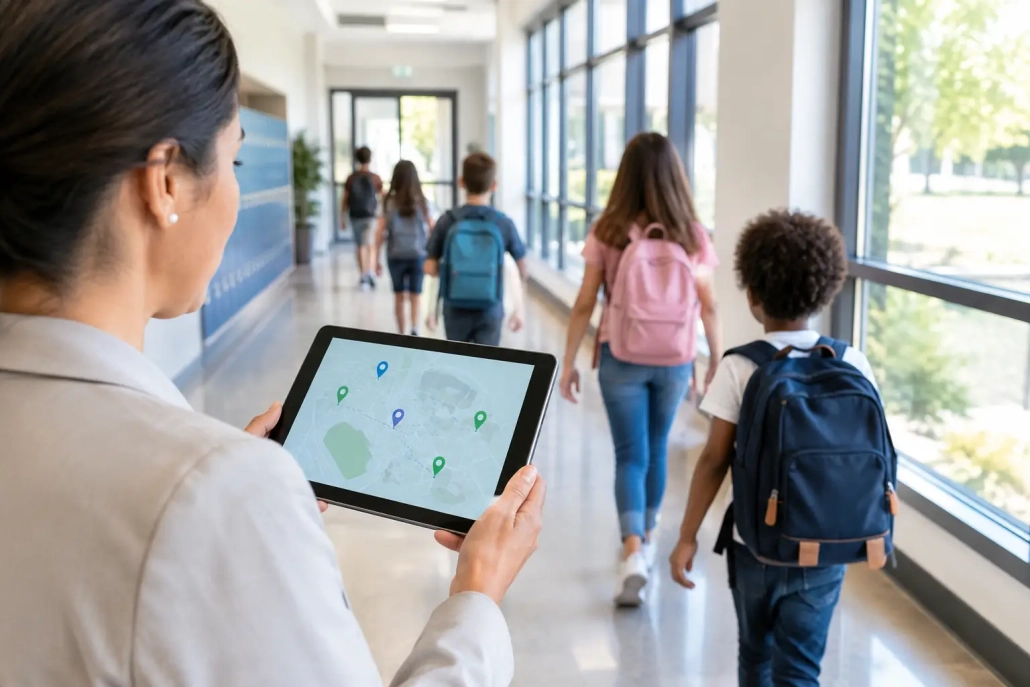
Student Movement Tracking Policy Guide for K-12
A student movement tracking policy guide gives schools a practical answer to a daily operational question: Where should a student be, and can staff confirm it quickly? Between arrival, class changes, restroom use, interventions, lunch, early dismissal, and extracurricular activities, student movement creates hundreds of accountability moments each day. A clear policy turns those moments into consistent procedures rather than judgment calls.
The goal is not to monitor students unnecessarily. The goal is to maintain an accurate, time-stamped record when student location affects safety, instruction, attendance, supervision, or family communication. For K-12 leaders, the strongest policies protect students and staff while reducing the paper slips, radio calls, spreadsheets, and follow-up work that slow down the school day.
Start With the Purpose of Student Movement Tracking
A policy should state why the school tracks movement before it defines the tools used to do it. Staff are more likely to follow a process when they understand the operational outcome. That purpose might include verifying that students arrived safely, reducing hallway congestion, supporting emergency accountability, documenting early departures, or identifying patterns that affect instructional time.
Avoid broad language such as “track all student activity.” It can create confusion and concern among families and staff. Instead, identify the school-controlled events where records are necessary. For example, a middle school may track arrival, first-period attendance, tardies, nurse visits, hall passes, cafeteria entry, dismissal, and visitors checking students out. An elementary school may focus more heavily on arrival, attendance, authorized pickups, intervention transitions, and bus dismissal.
The right scope depends on the school’s size, grade levels, layout, supervision needs, and existing procedures. A district policy can establish minimum standards, while building-level procedures define how each campus applies them.
Define the Moments That Require a Record
A policy is most useful when it names the movement events staff must record and the expected timing for each one. If the policy says that movement should be documented “promptly,” staff may interpret that differently. A stronger standard explains what prompt documentation means in practice.
For most K-12 schools, the policy should address at least these operational moments:
- Arrival and entry to campus or the building
- Daily classroom attendance and tardy status
- Movement from class through a hall pass or approved destination
- Transitions to specialized services, interventions, counseling, or health services
- Lunch, dismissal, transportation changes, and early checkout
- Emergency reunification, evacuation, lockdown, or other incident accountability
Each event should have a defined owner. Teachers may be responsible for classroom attendance and approving classroom departures. Front office personnel may own late arrivals, early departures, and guardian verification. Deans or campus supervisors may manage repeated tardies, restricted movement, or behavior-related consequences. School nurses, counselors, and intervention staff should have procedures that preserve appropriate confidentiality while confirming that a student has arrived when necessary.
The policy should also identify exceptions. A student with a documented medical plan may need flexible movement procedures. A student receiving specialized services may follow a recurring schedule that does not resemble a standard class transition. Exceptions should be handled through approved workflows, not informal workarounds that leave no record.
Set Clear Rules for Staff, Students, and Families
The best policies make expectations visible to everyone involved. Staff need clear procedures, students need simple behavioral expectations, and families need a plain-language explanation of how the school uses information.
For staff, document the required actions for common situations. Specify whether a teacher must issue a digital hall pass before a student leaves, whether the receiving location confirms arrival, and who resolves a pass that remains open after a reasonable period. Define how missed scans, device outages, substitute teachers, and late student schedules are handled. These details prevent inconsistent records and reduce disputes later.
For students, keep the expectations direct. Students should know when they need permission to leave class, how to carry or display an approved pass if required, where they are allowed to go, and what happens when they do not follow the process. The purpose is orderly movement and faster support, not a punitive system for ordinary needs.
For families, explain the categories of information collected, why the records are used, who may access them, and how long they are retained. This communication should align with district privacy policies and applicable student records requirements. Families are more likely to support a process that is specific, reasonable, and connected to student safety.
Build Privacy Into the Policy From Day One
Movement data can be useful, but it should not become a catch-all record of every student action. A sound policy follows a data-minimization approach: collect what the school needs for a defined purpose, make it available only to authorized users, and retain it only as long as required by district policy, law, or legitimate operational need.
The policy should define role-based access. A classroom teacher may need to see active passes for students assigned to that class, but not a student’s complete movement history. Attendance personnel may require access to arrival and dismissal records. School leaders may need broader reports to identify attendance trends or respond to an incident. District technology teams may need administrative access for support, but access should be logged and limited.
It is also wise to distinguish routine movement records from sensitive student information. A nurse visit, counseling appointment, disciplinary matter, or special education service may require tighter visibility rules. The policy should state that staff must not use movement data to speculate about student circumstances, share information informally, or access records without a school-related reason.
Retention, Corrections, and Audit Trails
Records need a retention schedule. Some data may be retained alongside attendance records, while short-term hall pass data may have a different lifecycle. Work with district records, legal, and privacy teams to establish the schedule rather than leaving it to individual buildings.
The policy should also allow for corrections. A scanner can miss a barcode, a student may arrive during a network interruption, or a teacher may select the wrong status. Staff should know who can correct a record, what documentation is needed, and whether the system preserves an audit trail. Correctable records are essential. Uncontrolled edits are not.
Choose Technology That Supports the Procedure
Technology should reinforce a school’s policy, not force staff into impractical routines. A system that requires too many screens, inconsistent devices, or duplicate entry will drive staff back to paper. The best implementation is simple at the point of use: scan, check in, issue a pass, verify arrival, or record a dismissal with minimal friction.
Before selecting or expanding a solution, map the current workflow from the student’s perspective and the staff member’s perspective. Ask where delays occur, where staff lack visibility, and where data has to be entered more than once. Then identify which records should flow into the student information system, attendance workflow, parent notification process, and administrative reporting.
An all-in-one platform can reduce gaps between arrival, classroom attendance, hall pass management, cafeteria activity, and dismissal. However, integration should be tested carefully. District teams should confirm student roster accuracy, user permissions, data synchronization timing, and the procedures staff will use if a connected system is unavailable.
SwipeK12 Solutions supports this operational approach by bringing real-time attendance, student accountability, movement tracking, and reporting workflows together in one configurable environment. The value is not simply faster scanning. It is a more reliable record that staff can use when a student needs support or a campus needs immediate accountability.
Train for Daily Use, Not Just Launch Day
A policy can be well written and still fail if staff do not know what to do during a busy passing period. Training should be role-specific and scenario-based. Teachers need to practice taking attendance, managing tardies, and issuing passes. Office teams need to process late arrivals and early pickups. Administrators need to run reports, review exceptions, and respond to incidents.
Short training sessions are often more effective than one large presentation. Provide quick-reference procedures for common situations, then reinforce expectations during the first weeks of implementation. Building leaders should monitor adoption early, not to look for blame, but to find steps that are unclear or unrealistic.
Substitute teachers deserve special attention. If substitutes cannot follow the process, attendance and movement data can become unreliable on the days a school most needs consistency. Provide a simple substitute workflow, clear contact information, and a backup method that can be entered into the system later.
Review the Data and Improve the Process
Movement tracking should produce actionable insight, not a dashboard that no one reviews. School leaders can use reports to identify recurring late arrivals, excessive time out of class, bottlenecks at entrances, repeated early checkouts, or locations receiving more students than expected. Those patterns can guide staffing decisions, supervision changes, counseling support, or family outreach.
Use data with context. A high number of hall passes from one classroom does not automatically indicate a classroom management problem. It may reflect a schedule change, a nearby restroom closure, a student support program, or an inaccurate procedure. Review patterns with the people closest to the workflow before making decisions.
Set a regular policy review cycle, typically at least once each school year and after any major incident, campus reconfiguration, or technology change. Ask staff where the process creates friction, whether records are accurate enough for decision-making, and whether privacy controls remain appropriate.
A student movement policy works when it helps adults act quickly and consistently without making the school day harder for students. Start with the accountability moments that matter most, make expectations easy to follow, and keep refining the process until the record reflects what is actually happening on campus.


Leave a Reply
Want to join the discussion?Feel free to contribute!