
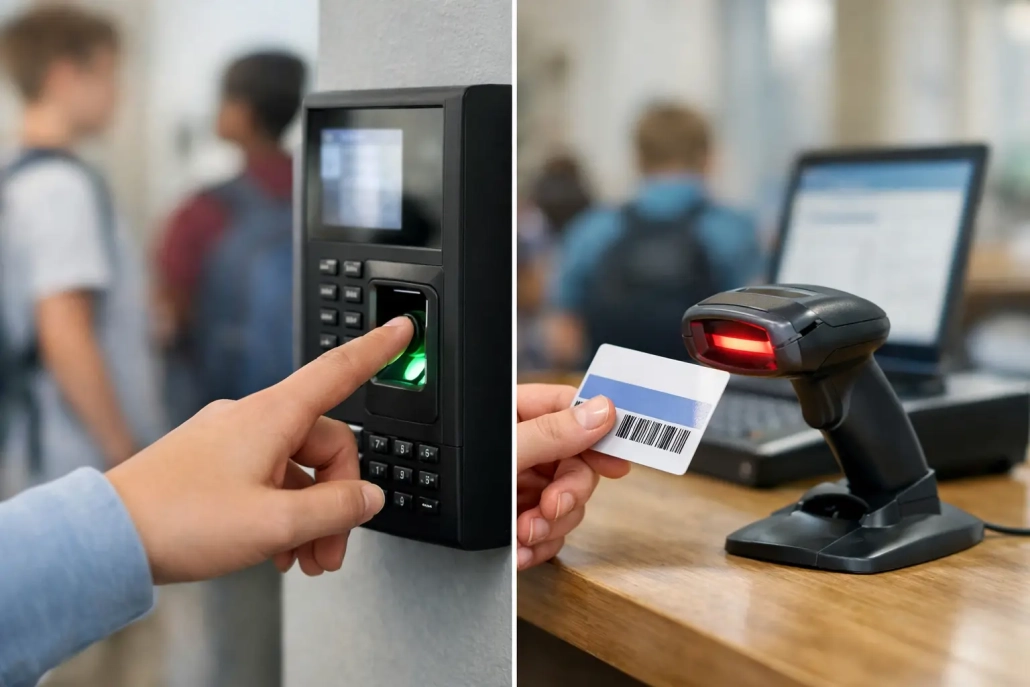
Biometric Versus Barcode Attendance for Schools
A crowded morning arrival line is not the place for attendance technology to create a new problem. School leaders need a clear, reliable record of who entered campus, who arrived late, and which students still need follow-up. In the decision between biometric versus barcode attendance, the best choice is rarely about which technology sounds more advanced. It is about which process staff can operate consistently while protecting students, supporting families, and producing usable data.
For most K-12 environments, barcode attendance offers the stronger balance of speed, flexibility, privacy, and cost control. Biometrics can address specific identity-verification concerns, but they also introduce policy, legal, and implementation questions that districts should evaluate before deployment.
What Each Attendance Method Actually Captures
Barcode attendance identifies a student when a staff member scans a barcode printed on an ID card, schedule, sticker, or digital credential. The scan can record an arrival, tardy, classroom presence, cafeteria visit, screening checkpoint, or departure event in real time. When connected to the student information system, that event can update the attendance workflow staff already use.
Biometric attendance identifies an individual through a physical or behavioral characteristic. In schools, that may include fingerprint, palm, facial, or iris recognition. Rather than presenting a credential, the student is matched to a stored biometric template.
The difference matters operationally. A barcode confirms that a recognized credential was scanned. A biometric system is designed to confirm that the person in front of the device matches a stored identity. That additional identity assurance may be valuable in limited situations, but it is not automatically necessary for routine school attendance.
Biometric Versus Barcode Attendance: The Core Trade-Off
The central trade-off is simple: biometrics can provide stronger person-to-record verification, while barcodes provide a more practical operating model for the daily realities of K-12 schools.
A biometric reader can reduce concerns about students presenting another student’s ID or checking in for a peer. But schools should ask how frequently that issue actually affects attendance accuracy, and whether supervision, tardy procedures, and exception review would address it without collecting sensitive biometric data.
Barcode systems require students to carry or access a credential. Cards can be forgotten, damaged, or shared. Yet those exceptions are visible and manageable. A front-office team can issue a temporary badge, search for a student record, or use a manual check-in method without stopping the entire arrival process.
Biometric systems create a different type of exception. A scanner may fail to recognize a student because of lighting, camera position, injury, dirty sensors, changed appearance, or poor network conditions. Facial recognition may also raise concerns about demographic performance differences and whether students are comfortable being scanned. When a biometric match fails, staff still need a fast fallback procedure.
The right question is not whether one method is perfect. Neither is. The question is which exceptions your team is prepared to handle at 7:35 a.m. when buses are unloading and the attendance office needs accurate records now.
Privacy and Family Trust Require More Than a Policy
Biometric data deserves a higher level of scrutiny than a student ID number. A lost ID card can be replaced. A biometric identifier cannot be changed in the same way. That distinction affects how families, boards, legal counsel, and community stakeholders may view the system.
Before choosing biometric attendance, districts should evaluate applicable state biometric privacy requirements, student records obligations, consent practices, vendor contracts, data storage, retention schedules, deletion procedures, and breach-response responsibilities. Requirements vary by state, and legal review should be part of the procurement process rather than an afterthought.
A district also needs plain-language answers for families. What biometric information is collected? Is an image retained, or only a template? Where is it stored? Who can access it? How long is it kept? Can a family opt out, and what attendance process will be used instead?
Barcode attendance usually presents a simpler privacy posture because it relies on an existing student identifier rather than a unique biological characteristic. That does not eliminate the need for security. Student records, scan histories, and location data still require role-based access, appropriate retention rules, and careful vendor oversight. But the conversation is generally more familiar to families and easier for schools to administer.
Speed at Arrival Is About Workflow, Not Just Scan Time
A vendor may describe a biometric match or barcode scan as taking seconds. School operations are measured in lines, staffing, bell schedules, and exceptions, not isolated transactions.
Barcode scanning works well because it fits naturally into high-volume routines. Students present their ID while entering a building or reporting to a designated station. Staff can see the student, monitor behavior, identify missing credentials, and address a late arrival in one interaction. The same barcode can support attendance, hall pass activity, cafeteria workflows, event check-in, and other campus accountability processes.
Biometrics may be quick when conditions are ideal, but real-world throughput depends on device placement, student behavior, enrollment quality, recognition performance, and the time needed to resolve failed matches. Schools considering biometrics should test the process with actual morning volume, not a small demonstration group.
A practical pilot should measure more than average transaction time. Track queue length, number of staff interventions, failed reads, late bell impact, student opt-outs, and the time required to correct records. Those are the numbers that reveal whether a system supports the school day or adds friction to it.
Cost and Scalability Change the Decision
Biometric attendance typically requires specialized devices, biometric enrollment, ongoing device management, and added compliance work. Costs can rise further when a district needs multiple entry points, replacement hardware, expanded support, or separate procedures for students who cannot or choose not to use the system.
Barcode programs are often easier to scale across a single building or an entire district. Schools can use printed IDs, existing badge printers, mobile devices, fixed scanners, or a combination based on each location’s needs. That flexibility matters for districts with different building layouts, staffing levels, and budgets.
Scalability also includes training. A solution is only as effective as the staff members who use it during arrival, class transitions, lunch, testing, field trips, and emergency accountability events. Barcode-based workflows are generally easier to explain because the action is visible: scan the student credential, verify the result, and follow the established exception process.
Attendance Accuracy Needs Context
Some schools approach biometrics because they want to eliminate proxy attendance. That concern is valid, particularly when attendance has financial, compliance, or safety implications. But biometric identity verification should not be treated as the only path to accurate records.
A well-designed barcode process can deliver highly dependable attendance data when it includes visible staff supervision, real-time validation, clear tardy rules, duplicate-scan alerts, temporary credential procedures, and SIS-integrated reporting. The system should make discrepancies easy to find and correct before they become chronic reporting issues.
Barcode attendance also gives schools useful operational context. A scan can be tied to a location, time, event type, and staff workflow. This supports more than daily presence. Leaders can see late-arrival patterns, identify students needing intervention, document movement through designated checkpoints, and coordinate parent notifications when a student is marked absent or tardy.
That is where an all-in-one campus accountability approach earns its value. Attendance should not live in a separate silo from student movement, hall passes, notification workflows, and administrative reporting. Platforms such as SwipeK12 Solutions are built to help schools turn routine capture points into timely, actionable information.
When Biometrics May Be the Better Fit
Biometrics may be appropriate when a school or district has a narrowly defined need for higher-confidence identity verification and the resources to manage the responsibility that comes with it. Examples could include restricted-access areas, specialized programs with strict custody requirements, or environments where credential sharing has been documented as a persistent problem despite stronger supervision and process controls.
Even then, deployment should begin with governance rather than hardware. Define the problem, establish success measures, obtain legal and privacy review, communicate with families, train staff, and maintain a non-biometric alternative for exceptions and opt-outs where required.
For routine arrival and classroom attendance, many schools will find that the extra complexity does not produce enough additional value to justify the privacy and operational burden.
A Better Way to Make the Decision
Start with the attendance outcome you need to improve. Is the priority reducing tardies, speeding up arrival, documenting campus presence, improving parent communication, preventing proxy check-ins, or giving administrators faster reporting? The answer should guide the technology choice.
Then map the workflow from the student’s perspective and the staff member’s perspective. Include the first bell, lost IDs, late buses, substitute staff, network interruptions, family questions, and end-of-day corrections. A system that performs well only under ideal conditions is not a dependable school operations system.
The strongest attendance program is the one staff can run confidently every day, students can follow without confusion, and district leaders can trust when decisions need to be made. For many K-12 schools, that means using barcode attendance as the practical foundation and building accountability around real-time data, clear procedures, and responsive support.


Leave a Reply
Want to join the discussion?Feel free to contribute!