
Student Accountability System Guide for K-12 Schools
The morning bell rings, but a missing student record can still create an immediate operational problem. A strong student accountability system guide starts with one practical question: Can your team confirm who is on campus, where they should be, and whether required actions have been documented in real time? For K-12 schools, that answer affects safety, attendance funding, family communication, and staff confidence throughout the day.
Paper sign-in sheets, disconnected spreadsheets, and delayed attendance corrections make accountability harder than it needs to be. The right system gives schools a reliable operational record without putting more work on teachers, front-office staff, or administrators.
What a Student Accountability System Should Do
Student accountability is more than taking homeroom attendance. It is the ability to document a student’s status and movement across the school day: arrival, classroom presence, tardiness, approved transitions, cafeteria activity, early dismissal, and departure.
A best-in-class system brings these records into one workflow. Staff should not need to search multiple tools to determine whether a student checked in late, left class with a pass, visited the nurse, or was dismissed by an authorized adult. When information is scattered, staff lose time during routine questions and may face unnecessary uncertainty during an emergency.
For school leaders, the goal is not to monitor students for its own sake. The goal is to create accurate, timely records that support student safety, positive behavior interventions, attendance improvement, and consistent policy enforcement.
Real-time visibility changes the response
A daily attendance report that is finalized hours later may satisfy a recordkeeping requirement, but it does not give staff the information they need at the moment a decision is required. Real-time accountability allows authorized staff to identify unaccounted-for students, verify a late arrival, confirm a location, or investigate a pattern before it becomes a larger issue.
That distinction matters during fire drills, lockdowns, medical incidents, parent pickup questions, and ordinary classroom transitions. Real-time data helps teams act with confidence rather than reconstruct events from incomplete records.
Build the System Around the School Day
The most effective accountability systems reflect how a school actually operates. A small elementary school may need fast morning barcode scanning and a dependable dismissal process. A large high school may also need class-by-class attendance, tardy kiosks, digital hall passes, visitor monitoring, and reporting across several buildings.
Start by mapping the student journey from arrival through dismissal. Identify each point where staff need a verified record, where students commonly bypass a process, and where paper workflows create delays. This exercise often reveals that the issue is not simply attendance capture. It may be late arrivals entering through several doors, inconsistent hall pass procedures, or a lack of visibility into early dismissals.
A practical design typically addresses four core moments:
- Arrival and first-period attendance, including late check-ins and absence verification.
- Classroom attendance and student movement during instructional time.
- Restricted or high-volume locations such as cafeterias, health offices, testing rooms, and school events.
- Dismissal, early release, and confirmation that students leave through approved processes.
Not every school needs the same combination of tools. The best approach is to establish consistent accountability at the points that present the greatest operational risk, then expand as staff adoption and district priorities evolve.
Choose Capture Methods That Staff Will Use
Technology only improves accountability when it fits the pace of the school day. A process that adds several minutes to every class period or requires staff to troubleshoot hardware will not produce reliable data for long.
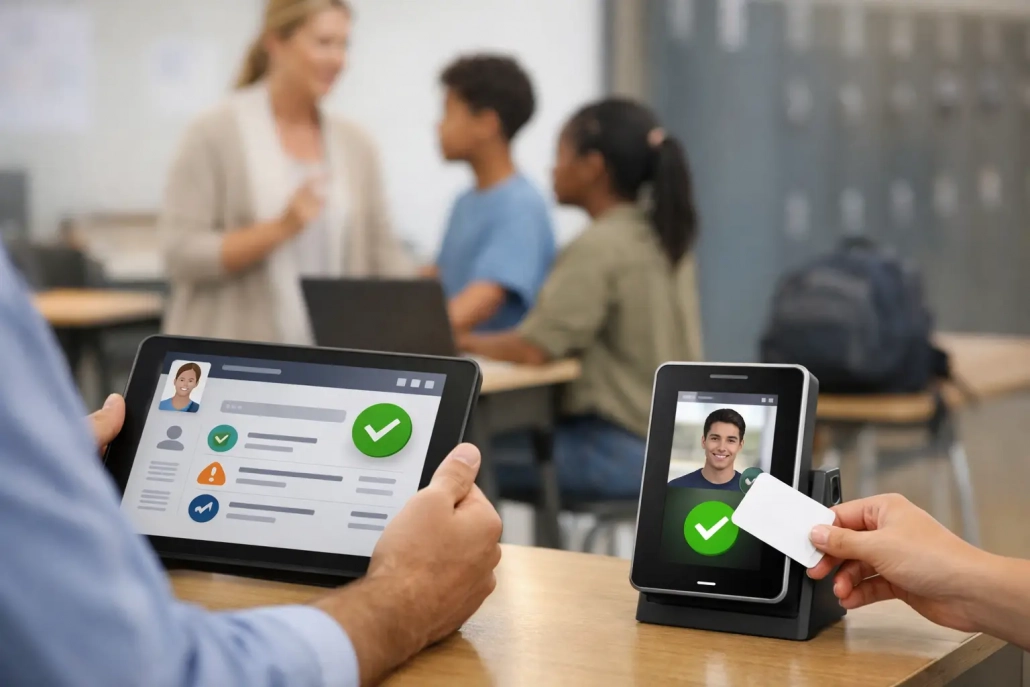
Barcode-based scanning can provide fast, consistent attendance capture for classrooms, arrival stations, cafeterias, and events. Mobile check-ins give administrators and support staff flexibility during field trips, assemblies, or student interventions. Kiosks can standardize tardy check-in and produce a timestamped record without placing the full burden on front-office staff.
The trade-off is worth considering. A fully automated approach can reduce manual work, but it may require greater coordination with IT, facilities, and the student information system. A simpler deployment can launch quickly and solve an immediate attendance challenge, yet it may leave some movement records outside the platform. Schools should select the model that matches their current capacity while preserving a clear path to scale.
Make SIS Integration a Requirement, Not an Afterthought
A student accountability platform should complement the student information system, not create a second source of truth. When attendance data must be entered twice, staff spend more time correcting records and less time supporting students.
Integration allows student rosters, schedules, demographic fields, and attendance codes to flow into the accountability workflow. In return, verified attendance and activity records can support district reporting, compliance processes, and outreach to families. The result is faster reconciliation and fewer opportunities for errors caused by outdated rosters or manual data entry.
Before selecting a solution, district teams should confirm how data is synchronized, who owns data validation, how schedule changes are handled, and what reporting fields are available. Ask what happens when a student enrolls midyear, changes a class, or arrives late after the initial attendance window. The answers reveal whether a platform can handle real school operations rather than only an idealized workflow.
Establish Clear Ownership and Response Rules
Accountability technology cannot replace policy. It should make policy easier to follow and easier to verify.
Define who is responsible for resolving unverified absences, reviewing tardy records, approving early dismissals, monitoring hall pass exceptions, and contacting families. Teachers need a workflow that is quick and clear. Attendance teams need escalation rules. Administrators need access to actionable reports, not a backlog of raw data.
Consistency matters especially when schools use accountability data for interventions or consequences. If one student receives a tardy record through a kiosk while another is manually excused without documentation, reporting loses credibility. Staff training should cover not only how to use the platform, but also when to use each attendance code and how exceptions are handled.
A short pilot with representative staff can help refine these rules before a full rollout. Include classroom teachers, attendance clerks, deans, school safety personnel, and front-office staff. Their feedback will identify friction that may not be visible in a district-level planning meeting.
Turn Records Into Timely Family Communication
Families are more likely to respond constructively when they receive accurate information quickly. A notification about a late arrival or unexcused absence is more useful when it reaches the parent or guardian while the event is still current, not days later after attendance has been reconciled.
Automated notifications can improve consistency, but schools should set thoughtful communication standards. Not every event needs the same message or escalation level. Repeated tardiness may call for a counselor intervention, while a first occurrence may only require a factual alert. Language access, contact preferences, and district communication policies should shape the workflow.
The goal is not to create more messages. It is to deliver relevant information early enough for families and staff to work together on a solution.
Measure the Operational Results
A student accountability system should produce measurable improvements, not just more data. Establish a baseline before implementation, then review results at regular intervals. Useful indicators include attendance completion rates, time required to reconcile daily records, tardy volume, unresolved absence counts, family contact turnaround, and the number of students who cannot be immediately accounted for during a drill.
Look beyond districtwide averages. A school may show improved overall attendance while one grade level, entry point, or class period continues to generate inaccurate records. Granular reporting helps leaders identify where training, staffing, policy adjustments, or additional capture points are needed.
SwipeK12 Solutions supports this all-in-one approach by combining attendance, student tracking, notifications, and campus monitoring in workflows that can adapt from a single school deployment to district-wide operations.
Start With the Problem You Need to Solve First
The strongest accountability initiatives do not begin with a long feature checklist. They begin with a recurring problem: too many manual tardy entries, unreliable classroom attendance, slow emergency roll calls, or limited visibility into student movement.
Solve that problem with a process staff can follow every day. Once the records are trusted, the system becomes more than a compliance tool. It becomes a practical foundation for safer campuses, faster decisions, and better-informed support for every student.


Leave a Reply
Want to join the discussion?Feel free to contribute!