
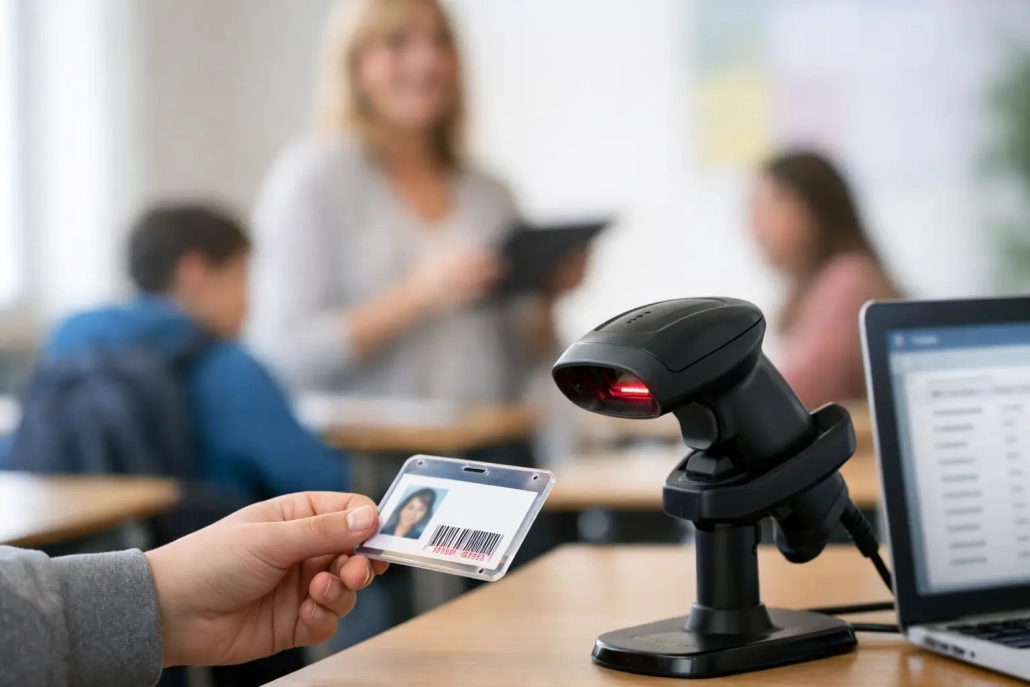
School Barcode Attendance Implementation Example
The first bell is not the problem. The problem is what happens in the 15 minutes after it: late students entering through multiple doors, staff writing names on paper, attendance clerks reconciling records, and administrators trying to identify who is actually on campus. This school barcode attendance implementation example shows how a K-12 school can replace that friction with fast, accountable arrival tracking that supports attendance accuracy, safety response, and family communication.
This is a practical model, not a one-size-fits-all prescription. A small elementary school may need a simple front-office scanning station. A large high school may need scanners at several entrances, classroom follow-up, late-pass workflows, and real-time SIS reporting. The right design depends on student volume, building layout, staffing, and local attendance policies.
The School Scenario: A High School With a Tardy Problem
Consider a high school serving 1,450 students across grades 9-12. Before implementing barcode attendance, the school used a mix of teacher roll calls, handwritten late slips, and manual data entry. Students who arrived after the bell often entered through different doors, while attendance staff spent the first part of every morning sorting out who was absent, who was late, and who had simply not been marked correctly.
The school leadership team set three operational goals: capture late arrivals in real time, reduce the time staff spent managing paper slips, and give deans a current list of students who needed intervention. They also wanted the process to work with existing student ID cards and feed attendance events into the district’s student information system.
The answer was not simply placing one scanner in the main office. That would have created a line, shifted work to one staff member, and missed students entering through approved side entrances. The implementation team designed the workflow around the actual movement of students.
School Barcode Attendance Implementation Example: The Workflow
Each student already had an ID card with a unique barcode. The school configured the barcode system to match each student record from the SIS, including student name, grade, homeroom, schedule, guardian contact preferences, and applicable attendance codes.
At the beginning of the school day, trained staff members operated barcode scanners at the main entrance and two high-volume student entrances. A student arriving on time could pass through without creating an extra step. A student arriving after the designated bell time scanned their ID before proceeding to class.
The scan immediately recorded the student as present and late, with the date, time, location, and staff station attached to the event. Based on the school’s policy, the system could print or display a late pass, send the student to a designated check-in point, or allow them to move directly to class. The attendance office no longer needed to decipher handwritten names or wait for stacks of paper slips to arrive.
For students without an ID card, staff searched by name or student number, verified the student identity, and recorded the event through the same workflow. That exception process matters. Lost, damaged, or forgotten IDs will happen, and a strong implementation keeps those exceptions from creating a second manual system.
By the time first-period teachers took classroom attendance, late arrivals were already visible in the attendance system. Teachers could focus on confirming remaining absences rather than correcting a long list of students who had walked in after the bell.
What the School Configured Before Launch
Technology is only as effective as the policy behind it. Before the first scanner went live, the implementation team documented which doors would be staffed, what counted as tardy, which attendance codes would apply, and who had authority to override an event.
The school also established a practical escalation path. A first tardy could generate a standard record and family notification. Repeated tardies could appear on a dean’s intervention list. Students arriving significantly late could be directed to the attendance office for verification, particularly when a parent note, transportation issue, or safety concern needed review.
The team configured four core elements:
- Entrance and scanner locations based on actual student traffic patterns
- Tardy windows, attendance codes, and exception rules aligned with district policy
- Staff permissions for scanning, editing records, viewing reports, and approving overrides
- SIS data exchange schedules so attendance records remained current and defensible
These decisions prevented a common implementation failure: installing equipment first and defining procedures later. Barcode attendance should reinforce the school’s operating model, not force staff to invent one during morning arrival.
Training That Makes the Process Stick
The school’s scanner training took less time than the old process consumed in a single week, but it was specific. Staff practiced scanning student IDs, looking up students without cards, handling duplicate scans, recognizing error messages, and directing students who required a late pass or office follow-up.
Teachers received a separate, shorter training focused on what changed in the classroom. Their role was to verify attendance, review any discrepancies, and avoid sending students back out of class simply to obtain a paper slip. Deans and attendance officers learned how to run real-time tardy reports, identify repeat patterns, and correct records with an audit trail.
A pilot period is valuable, especially in a large building. In this example, the school tested the system with one entrance for five school days. The pilot exposed a bottleneck during bus arrival, so administrators moved one scanner closer to the student drop-off zone and assigned an additional staff member for the first 20 minutes. That adjustment was simple because the team had measured the real arrival pattern rather than guessing at it.
The First 30 Days: What Leaders Should Measure
A barcode attendance rollout should be evaluated through operational outcomes, not just whether scanners turn on. During the first month, the school monitored scan volume by entrance, average check-in time, unverified absences after first period, number of manual corrections, and tardy incidents by student and grade level.
The school also reviewed whether family notifications were accurate and timely. A notification sent promptly after a verified tardy can start a more productive conversation at home. But notifications should follow the school’s review rules. Automatically alerting families about every raw scan event may create confusion when a student has an excused transportation delay or a legitimate appointment.
Within several weeks, attendance staff had a clearer morning workflow. Instead of spending first period collecting and keying in late slips, they reviewed exceptions and resolved records that actually required judgment. Deans could see repeat tardiness before it became a semester-long pattern. School leaders gained a more reliable view of who had arrived, where the check-in occurred, and when the record was created.
Where Barcode Attendance Delivers the Most Value
For this high school, the immediate gain was faster tardy capture. The longer-term value was accountability. Every scan created a time-stamped record that could support attendance reporting, student conferences, parent outreach, and safety procedures.
Barcode attendance is particularly effective when a school has high student volume, multiple points of entry, frequent tardies, or a paper-heavy late-pass process. It can also support alternative programs, after-school events, testing sessions, cafeteria accountability, and student movement checkpoints when the same platform is configured for those workflows.
Still, barcode scanning is not the best answer for every attendance moment. Classroom attendance remains essential for confirming that a student is actually present in the instructional setting. Mobile check-in may be a better fit for field trips, remote locations, or staff-supervised activities. The strongest approach combines arrival capture with classroom verification and clear exception handling.
Building a Scalable Attendance Model
A successful rollout begins with one question: where does your current attendance process lose time, accuracy, or visibility? For some schools, it is the front office. For others, it is late arrival, early dismissal, hallway movement, or delayed SIS updates.
SwipeK12 can help schools map those daily pressure points into an all-in-one barcode attendance workflow that fits their building, policies, and reporting needs. The goal is not more technology at the door. It is a dependable process that gives staff timely information and gives students a clearer path to being counted, supported, and ready to learn.


Leave a Reply
Want to join the discussion?Feel free to contribute!