
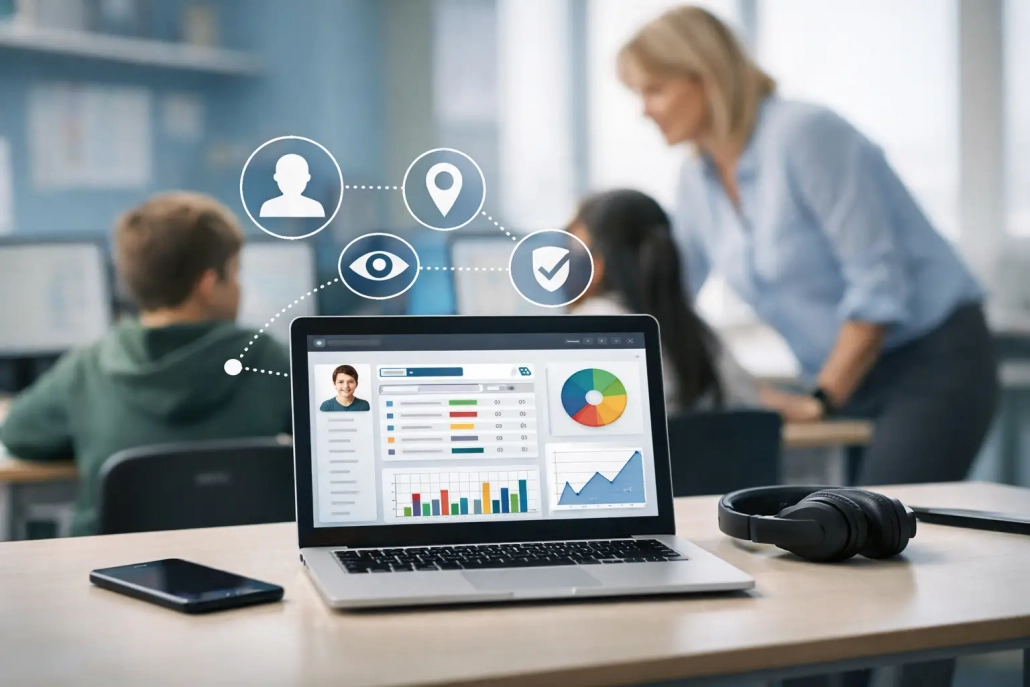
What Software Tracks Students in School?
At 9:17 a.m., the front office gets a call from a parent asking whether their child made it to first period. If your team has to check paper logs, call the classroom, and hope someone answers, the problem is not effort. It is visibility. That is usually the real question behind what software tracks students in school – not just what the system is called, but whether it gives staff accurate, real-time accountability without slowing down the school day.
For most K-12 schools, student tracking software is not one single tool. It is a category of systems that helps schools document where students are supposed to be, where they actually are, and when staff need to act. Depending on the campus, that can include attendance software, tardy kiosks, hall pass management, check-in and check-out workflows, visitor monitoring, cafeteria accountability, health screening, and SIS-connected reporting.
What software tracks students in school today?
In practical terms, the software that tracks students in school usually falls into a few connected functions. The first is attendance management. This is the core layer that records whether students are present, absent, tardy, or checked out. Many schools still rely on teacher entry alone, but stronger systems add barcode scanning, mobile devices, classroom scanners, front-office kiosks, and automated timestamping to reduce human error.
The second function is movement tracking during the day. That includes digital hall passes, late arrival check-ins, nurse and office visits, early dismissals, and other transitions that matter for both accountability and safety. Schools often discover that official attendance is only part of the picture. A student may be marked present in homeroom and still spend much of the day unaccounted for if there is no structured movement tracking.
The third function is reporting and notifications. Good systems do not just collect data. They organize it into actionable information for attendance teams, assistant principals, deans, district staff, and families. That can include absence reports, tardy trends, class-cutting patterns, campus entry logs, and parent alerts triggered by specific events.
The main types of student tracking software schools use
If you are evaluating what software tracks students in school, it helps to separate broad categories from actual operational needs. Many campuses need more than one feature, but they do not want five disconnected platforms.
Attendance software
Attendance software records daily and period-by-period presence. At a basic level, teachers mark attendance in a portal. More advanced systems support barcode badges, classroom scanners, kiosks, mobile check-ins, and automated synchronization with the student information system. This is often the starting point because attendance data drives funding, compliance, intervention workflows, and parent communication.
Tardy and late check-in systems
These systems are built for high-volume morning traffic and front-office efficiency. Students can scan in, receive a printed pass, and create a clean timestamped record without a staff member manually processing each arrival. For schools dealing with chronic tardiness, that speed matters. It keeps lines moving while giving administrators reliable data for consequences, interventions, and trend monitoring.
Hall pass and student movement software
Digital hall pass tools track where students are allowed to be during class time. They can show who left class, when they left, where they were headed, and whether too many students are out at once. This matters most on campuses where hallway traffic, class cutting, or repeated office and restroom visits create discipline and supervision gaps.
Check-in, check-out, and campus accountability systems
These platforms log student arrivals, early dismissals, returns from appointments, alternative placement transitions, and other movement events throughout the day. For schools focused on security and documentation, these workflows reduce guesswork. Staff can verify who is on campus, who left, and whether release procedures were followed.
Visitor and shared-campus monitoring tools
While not always labeled student tracking software, visitor systems and shared accountability tools support the same mission. They help schools separate student records from visitor access, maintain safer entry points, and build a more complete picture of who is in the building at any given time.
What the best software should actually do
Schools do not need more dashboards. They need software that works in real conditions: crowded entrances, limited staffing, inconsistent Wi-Fi pockets, substitute teachers, changing bell schedules, and compliance demands that never slow down.
A strong student tracking platform should capture data in real time. If there is a 20-minute delay between an event and the record, staff are making decisions with old information. It should also fit the way schools operate. Elementary schools, large high schools, charter networks, and rural districts do not move students the same way, so flexibility matters.
Integration is another non-negotiable. If the software does not connect with the SIS, staff end up doing duplicate entry, reconciling mismatched records, and losing confidence in the data. The best systems support automated reporting, clean data transfer, and workflows that do not add friction for teachers or front-office staff.
Usability matters just as much as features. A powerful system that takes weeks of retraining to handle daily attendance is not a practical win. School teams need intuitive screens, fast scanning, clear role-based access, and support that responds when an issue affects the school day.
Why schools ask what software tracks students in school
Usually, this question comes up when current processes are breaking down. Attendance may be inconsistent between classrooms. Tardy lines may back up into the hallway. Parents may call for confirmation that a student arrived, and staff may not have a fast answer. Administrators may suspect class cutting, but not have enough documentation to act confidently.
There is also a bigger shift happening in K-12 operations. Schools are expected to do more with fewer manual processes. Attendance is no longer just a compliance item. It connects directly to student safety, chronic absenteeism reduction, family engagement, intervention planning, and district oversight. When student tracking is fragmented, those efforts stay fragmented too.
That is why many districts move toward all-in-one platforms instead of stand-alone tools. They want one system that supports attendance capture, campus movement, accountability, notifications, and reporting in one place. That creates faster decisions and stronger consistency across buildings.
What to ask before choosing student tracking software
The right fit depends on your campus model. A single-school deployment has different priorities than a district-wide rollout, and a high school with multiple entry points has different needs than an elementary campus with one front office.
Start with your operational pressure points. If your biggest issue is morning congestion, focus on fast tardy processing and automated parent alerts. If your challenge is daytime accountability, hall pass and movement tracking may matter more. If your district needs better audit trails and cleaner compliance reporting, SIS integration and centralized reporting should move to the top of the list.
It is also worth asking how the system handles scale. Some products work well in one building but become difficult when multiple schools need different rules, bell schedules, permission levels, and reporting structures. A platform should adapt to your procedures without forcing every campus into the same model.
Support is another real differentiator. In school operations, software is only as good as the response when something needs to be adjusted quickly. Implementation guidance, training, and ongoing service are not extras. They are part of whether the system succeeds.
A better way to think about student tracking
When school leaders ask what software tracks students in school, the best answer is not a brand category alone. It is a system that makes attendance and accountability visible in real time, supports safety, reduces administrative friction, and scales with the way your schools actually run.
That is why many K-12 teams look for an all-in-one approach rather than piecing together separate attendance, tardy, pass, and reporting tools. A unified platform can give teachers, office staff, deans, and district leaders one source of truth. For schools that need faster check-ins, cleaner records, stronger parent communication, and more control over student movement, that operational clarity is where the real value starts.
SwipeK12 Solutions is built around that reality: practical workflows, real-time accountability, and flexible implementation for schools and districts that need systems staff will actually use. The right software should not make your day more complicated. It should help your team know who is on campus, where students are supposed to be, and what needs attention right now.
If your current process still depends on paper, delayed updates, or too many manual handoffs, the question is no longer whether student tracking software matters. It is whether your school has enough visibility to act with confidence when it counts.


Leave a Reply
Want to join the discussion?Feel free to contribute!